Investment Management USA Hiring Outlook 2026
January 2026
Investment Management USA Hiring Outlook 2026
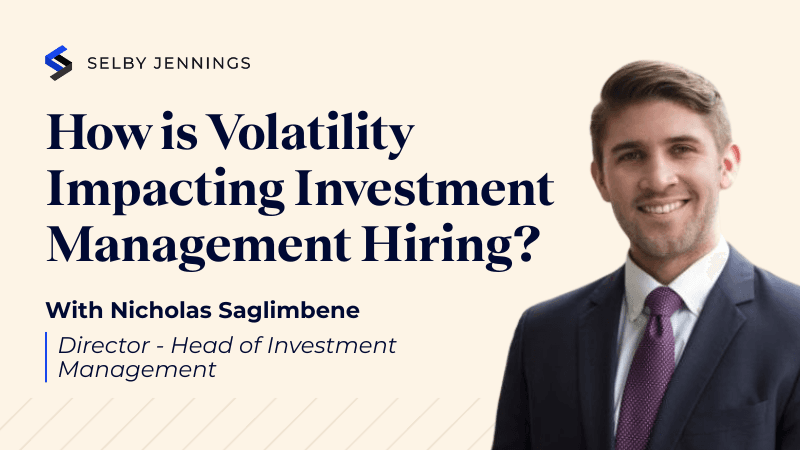
Investment management firms are entering 2026 with sharp focus on where talent can directly support performance. Over the past year, hiring strategies have become more selective, compensation expectations have risen, and firms have placed greater emphasis on experience, track record, and role clarity.
In this article, Nicholas Saglimbene, Director – Head of Investment Management at Selby Jennings, outlines how these changes will impact investment management hiring in 2026.
What changed in investment management in 2025, and how will it shape 2026?
"Hiring patterns diverged sharply across the sector in 2025. In private markets, demand at the junior level softened, while senior hiring remained active. Firms prioritised originations, portfolio management, value creation and workout expertise, reflecting a strong focus on experience and execution.
"In public markets, higher dispersion and volatility increased the value of stock picking and relative value strategies across both long-short equity and long-short credit, which has driven demand toward sector specialists, event-driven investors, and credit analysts with restructuring experience. In credit, stronger primary issuance windows helped, but uneven secondary liquidity kept interest high in investment grade (IG) and high yield (HY) analysts, distressed and special situations talent, and capital structure generalists.
"Investor relations teams also expanded. Fundraising, product specialist, and client service roles were in higher demand, with firms moving toward more specialised role design rather than broad, generalist coverage."
What hiring challenges will the investment management sector face in 2026?
"Volatility continues to shape hiring behavior. In several areas, the market is very candidate-driven, particularly for experienced professionals, which has pushed compensation higher and slowed decision-making on both sides.
"Across public markets, many top performers are risk-averse. Even when compensation is compelling, movement is slower, especially among PMs and analysts with strong multi-cycle track records. Competition tends to concentrate around a small group of validated performers, where references, intellectual property portability, and confidence in platform stability become decisive.
"Fundraising pressure is adding another layer of complexity. As capital raising becomes more competitive, firms place greater value on experienced investor relations talent, which further supports a candidate-driven market and rising compensation expectations."
What are the hardest-to-fill investment management roles in 2026?
"Originations professionals with established track records and deep relationships are among the most difficult profiles to attract and retain across private markets.
"In public equity, firms struggle most with sector-specialist analysts and PMs in areas such as health tech, semiconductors, energy transition, and industrial automation. Event-driven, special situations, and merger arbitrage profiles also remain scarce, particularly when they bring strong judgement around regulatory timelines and deal risk.
"On the credit side, distressed and restructuring analysts with legal and process fluency are consistently hard to secure. Capital structure investors who can move across loans, bonds, equity and derivatives, while managing liquidity effectively, remain in short supply.
"Investor relations hiring will stay competitive as well, especially for fundraising and distribution roles, and product specialists aligned to niche strategies."
How should firms update their investment management hiring strategy for 2026?
"Speed matters more than ever. Firms that act quickly, keep options open, and engage with passive talent early are far better positioned to secure strong candidates.
"Clarity is just as important. In public markets, candidates increasingly expect early transparency around capital allocation, risk budgets and seat economics. Flexible structures can also help, including carve-out sleeves or co-PM tracks, particularly when trying to attract validated performers who are cautious about moving.
"For investor relations roles, firms need to be prepared for higher compensation packages and faster processes. Delays often result in losing candidates to competitors who move decisively."
How are candidate expectations changing in investment management in 2026?
"Across the board, candidates are becoming more selective. In private markets, there are often more open roles than available candidates, and many professionals are reluctant to leave their current firms.
"Candidates in public markets want clarity. That includes capital allocation, risk limits, decision rights, and how performance is measured. Compensation expectations are increasingly tied to P&L participation, with demand for transparent scorecards and a clear understanding of mandate and culture before committing to a move.
"In investor relations, expectations continue to rise. Candidates want stronger compensation, earlier exposure to clients, and greater selectiveness when evaluating opportunities."
How will AI change investment management teams in 2026?
"AI adoption is largely focused on support functions rather than core investment decision-making. In private markets, it is being used to assist with administrative tasks and early-stage screening, while investment judgement remains human-led.
"Public market teams are using AI more heavily for data ingestion and cleaning, entity resolution, and document tagging across filings and transcripts. Investor relations teams are also applying AI to automate parts of marketing material production, helping teams scale output without proportionate headcount growth."
Which regulations will impact investment management teams in 2026?
"No major regulatory changes are expected to affect private market teams directly in 2026, but in public markets, data governance is becoming more important. Firms are expected to formalise data lineage, licensing, and usage policies, particularly where AI inputs and datasets are involved.
"A notable development on the investor relations side is expanded access to private market investments through 401(k) platforms. This has accelerated partnerships between retirement specialists and alternative asset managers, driving demand across fundraising, product, and client service functions."
What will be the biggest growth areas in investment management in 2026?
"Private credit is one of the most active growth areas, alongside investing insurance assets, secondaries, GP stakes, and asset-based finance. Private equity activity has also picked up after a slower period.
"In public markets, growth continues across sector-specialist equity strategies, event-driven investing and themes such as energy transition, industrial automation, semiconductors, and AI. Credit growth is concentrated in HY and IG relative value, distressed and special situations, capital structure trades, and opportunistic credit linked to refinancing cycles.
"Investor relations growth is strongest across private wealth platforms, family offices, high-net-worth channels, and insurance-related distribution."
Where are firms increasing their investment management headcount in 2026?
"Hiring will be highly targeted this year, with headcount decisions being closely tied to platform strategy rather than general expansion in private markets.
"Public market firms are adding talent across sector-focused equity pods and event-driven teams, while credit platforms continue to build HY, IG, and distressed capability. Investor relations teams are expanding most consistently, particularly across fundraising, client services, and product specialist roles."
What investment management compensation trends will impact hiring in 2026?
"Compensation continues to rise across several areas. In private markets, more firms are making carry available at mid and junior levels to stay competitive with larger platforms.
"Public market compensation is becoming more transparent. Validated performers are seeing higher fixed and variable pay, guaranteed draws or sign-ons to offset move risk, and clearer P&L participation structures with defined cliffs and vesting.
"Investor relations salaries are rising across the board, but fundraising roles are seeing some of the strongest upward pressure on compensation."
Download our USA Investor Relations Compensation Guide for the latest benchmarks, or click here for NCY-specific investment management salary guidance.
How should firms adjust investment management pay and incentives to stay competitive?
"Balancing short-term cash with long-term incentives is key. Firms need a clear view of market rates and should structure packages that combine salary with carry, equity, or P&L participation where appropriate. Working closely with a specialist talent partner like Selby Jennings can help you to achieve this.
"Public market teams also need to provide clarity around capital and risk alongside compensation. Performance-linked accelerators, sign-on guarantees and retention kickers for the first one to two years are increasingly common. The same principles apply across investor relations roles, where long-term alignment matters just as much as headline pay."
What’s causing investment management retention challenges in 2026?
"Retention pressure often links back to fundamentals. In private markets, fundraising conditions, deal flow, and the ability to deploy capital all influence satisfaction.
"Public market attrition is driven by performance dispersion, tighter risk budgets, and concerns around platform stability or compensation structure. Turnover within investor relations increases when fundraising becomes more competitive or performance disappoints."
How can leaders reduce attrition risk and strengthen retention in investment management?
"Retention improves when firms get the fundamentals right. Competitive compensation and flexible working arrangements are important, particularly in private markets. Good growth and development opportunities also play a major role in keeping talent engaged.
"In public markets, retention is stronger when firms provide transparent capital and risk budgets, along with stable mandates and consistent governance."
How can leaders build stronger investment management teams in 2026?
"Strong investment management teams are built through clarity, collaboration, and mentorship. Setting transparent expectations and encouraging cross-functional collaboration between research, trading, risk, and data teams improves performance across all private and public markets."
Speak with Nicholas Saglimbene and the Selby Jennings investment management team
If your firm is hiring across private markets, public markets, or investor relations in 2026, request a call back from Nicholas Saglimbene and the Selby Jennings investment management team for support with hiring strategy, specialist searches and compensation benchmarking. Learn more about our investment management talent solutions.
Investment management professionals exploring new opportunities can create an account and submit their CV to access exclusive roles and tailored support from Selby Jennings. Browse current investment management vacancies at industry-leading firms.