

July 20266 minute read
Searching Smarter Podcast: The Skills AI Can’t Replace in Finance Careers
AI is transforming financial services. The professionals who succeed will be those who know how to work alongside it.
Artificial intelligence is reshaping every corner of the financial services industry, from investment research and trading to risk management and client service. As firms continue investing in AI, one thing hasn't changed: organisations still rely on human judgment to make their most important decisions.
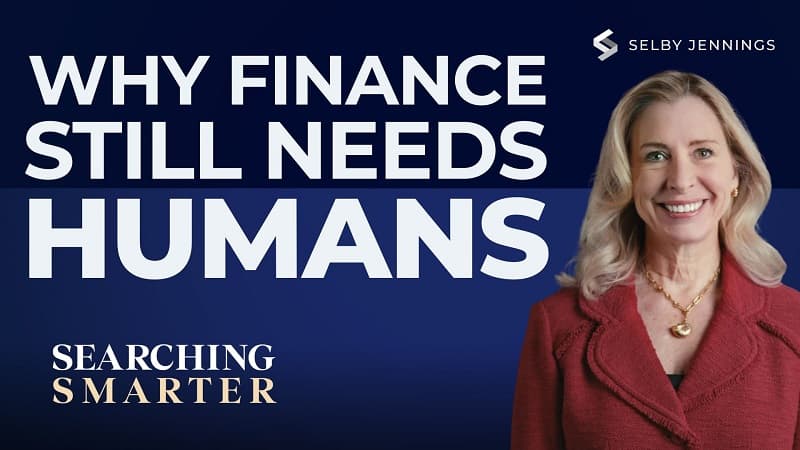
In this episode of Searching Smarter, host Jesse Skaff sits down with Rebecca Patterson, former Chief Investment Strategist at Bridgewater Associates and current Senior Fellow at the Council on Foreign Relations, to discuss how AI is changing finance, why human judgment remains essential, and how students and early-career professionals can prepare for the future of the industry.
About the guest
Rebecca Patterson is the former Chief Investment Strategist at Bridgewater Associates and, currently, a Senior Fellow at the Council on Foreign Relations. Throughout her career, she has advised institutional investors on global markets, macroeconomic trends, and investment strategy, bringing more than 30 years of experience across financial services.
Questions answered in this episode:
- How is AI changing financial services today?
- Which skills will become more valuable as AI adoption grows?
- Should finance professionals prioritise AI fluency or communication and critical thinking?
- How will AI change investment research and decision-making?
- Why does human judgment remain essential in an AI-driven industry?
- What advice would Rebecca Patterson give students and early-career professionals entering finance today?
AI is everywhere, but implementation is still catching up
Artificial intelligence is already influencing research, analytics, trading, risk management, customer service, and marketing across financial services. While firms are investing heavily in the technology, Rebecca explains that implementation is often more challenging than the headlines suggest.
Many organisations are still integrating AI into existing workflows while managing cybersecurity, data quality, and governance. Even firms with valuable proprietary data often face practical challenges turning that information into meaningful competitive advantages.
Throughout the discussion, Rebecca returns to one consistent message: AI should complement human judgment, not replace it. Clients, investors, and organisations still expect people to make the decisions that carry responsibility and accountability.
Key topics:
Rather than asking AI to simply validate an idea, Rebecca recommends using it to identify weaknesses in your thinking. Asking questions like "What am I missing?" or "What else should I be thinking about?" can help finance professionals test assumptions, reduce confirmation bias, and make more informed decisions.
Used this way, AI becomes a valuable complement to human judgment rather than a substitute for it.
AI has the potential to transform investment research by analyzing vast amounts of information more quickly than ever before. Rebecca discusses how investors are already experimenting with AI models to support market analysis and generate new perspectives.
However, she believes major investment decisions will continue to require human oversight. Experience, accountability, and the ability to connect information across economics, geopolitics, markets, and human behavior remain difficult to automate.
Beyond AI, Rebecca shares her perspective on one of the biggest structural challenges facing global markets: rising government debt.
She explains how increasing public-sector borrowing, higher long-term bond yields, and continued geopolitical uncertainty could have lasting implications for economic growth and investment markets. It's a reminder that while AI is transforming finance, broader macroeconomic forces will continue shaping investment decisions.
Rebecca closes the conversation with advice that may surprise many professionals.
As AI becomes better at producing information, the ability to interpret that information becomes even more valuable. Reading widely helps build context, strengthen critical thinking, and develop the judgment needed to ask better questions and make better decisions throughout a finance career.
Rebecca's message is not that finance professionals should compete against AI, but that they should learn to work alongside it.
Those who combine technical fluency with communication, curiosity, critical thinking, and sound judgment will be best positioned to succeed as financial services continues to evolve. AI will undoubtedly change how work gets done, but the ability to interpret information, connect ideas, and make thoughtful decisions will remain distinctly human.
Want more?
At the Searching Smarter podcast, we speak to the brightest and boldest minds in financial sciences & services. From talent acquisition leaders and hiring managers to world-class professionals, we delve into all the ways they leverage top talent to drive their businesses forward. Listeners will walk away with expert guidance on how to attract, acquire and retain high-performing teams, as well as what it takes to be a part of one.
It's available on Spotify, YouTube, Apple Podcasts, or wherever you get your podcasts. So listen, learn, and let us know what you think.
FAQ
AI is improving efficiency across research, trading, risk management, analytics, customer service, and investment operations. While adoption continues to accelerate, firms still rely on human professionals to oversee AI systems, interpret results, and make important business and investment decisions.
AI is changing how investment professionals work, but Rebecca argues that human judgment remains essential. Accountability, experience, communication, and the ability to connect information across different disciplines continue to play a critical role in investment decision-making.
Alongside technical knowledge, finance professionals should develop communication, critical thinking, creativity, curiosity, and strong decision-making skills. Understanding how to work with AI, rather than relying on it, will become increasingly important.
Yes. Rebecca encourages students and early-career professionals to become comfortable using AI tools and understanding their capabilities. At the same time, she emphasizes the importance of developing broader knowledge, strong judgment, and communication skills that technology cannot easily replace.
Find the talent you need
Get in touch with one of our consultants who can offer bespoke guidance on hiring for your business objectives and resourcing plans.
Looking for a new role?
Finding the right opportunity is an important part of shaping your future. Start your search today and move forward in your career.