

How AI is Changing the Way Firms Hire Data Talent
July 2026Ryan Gregory & Rico Cottell3 min read
How AI is Changing the Way Firms Hire Data Talent
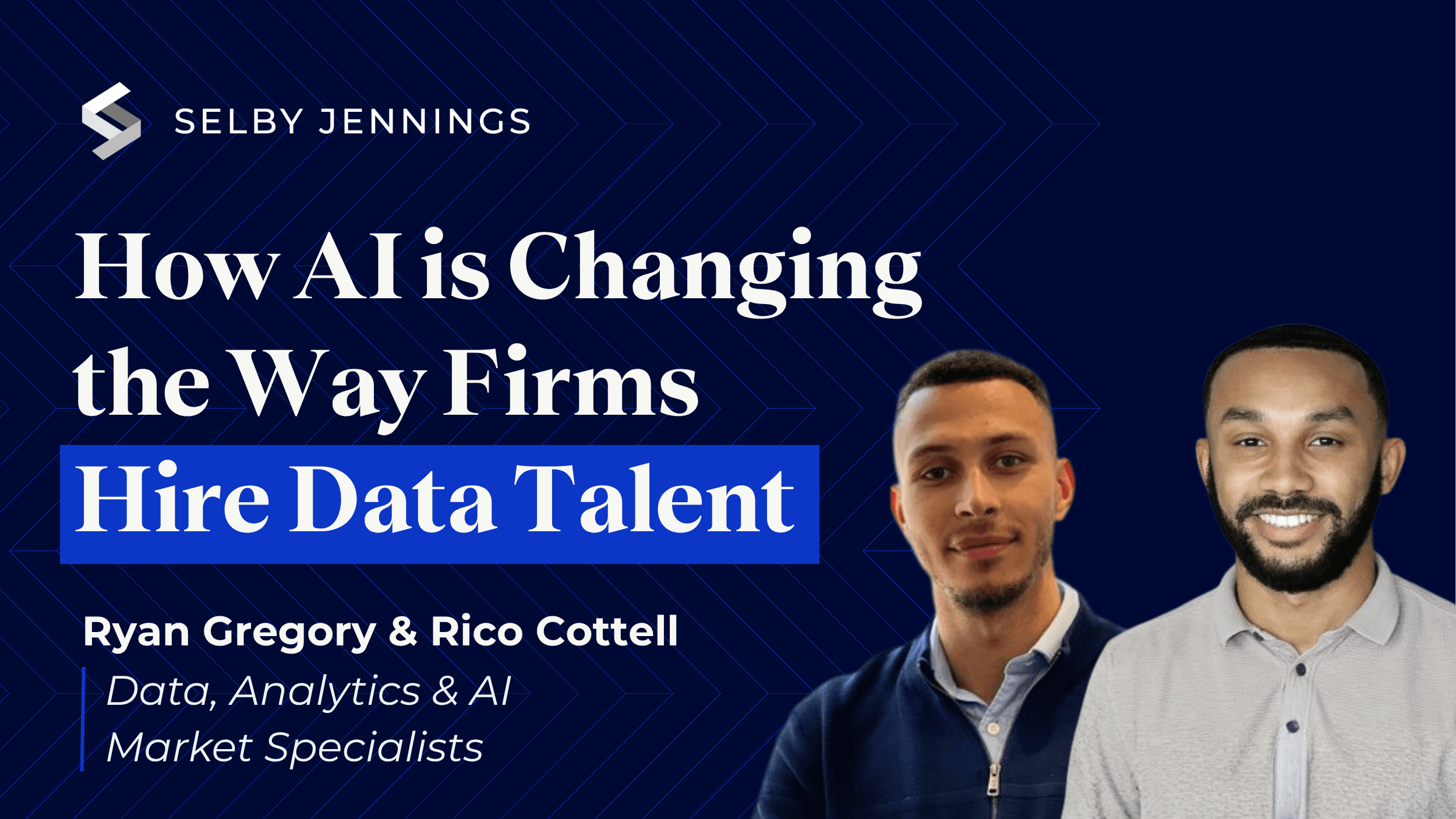
Streamlining your hiring process is sensible, but what if you’re unintentionally screening out the best data engineers?
We sat down with Ryan Gregory and Rico Cottell, two of our expert consultants in data, analytics and AI, to look at the current trends in hiring, and why the traditional technical assessments are losing their relevance.
Across AI engineers, data engineers, and data scientists, are there any interesting hiring trends that you’ve spotted?
Rico:
“We’re seeing AI and machine learning engineering become increasingly specialised across investment banks, hedge funds, asset managers, and the wider vendor landscape. Demand is particularly strong for engineers who can bridge advanced AI capabilities with real-world business outcomes, whether that is research acceleration, workflow automation, front office decision support, investment intelligence platforms, or revenue-generating front office applications. I recently placed someone who only had a couple of years’ experience, but it was such specialised work in AI that they were able to command a £300K package, for example.
“The market is so young you’re not going to find someone with decades of experience. 3-5 years in the field is the sweet spot right now, but even then, the salary range is wide. Anywhere from around £100K to £300K before any bonuses.”
Ryan:
“Many of the strongest AI candidates have options across technology firms, financial services and fast-growing startups. Compensation remains important, but firms are increasingly having to compete on factors such as ownership, impact, access to data and the quality of the problems being solved.”
Rico:
“One of the fastest-growing areas is agentic AI. While many firms initially focused on productivity use cases, we're now seeing significant investment in applications that can directly support decision-making, research processes and alpha generation. Across both the buy side and sell side, demand for AI/ML Engineers who can build scalable systems, evaluate models effectively and integrate AI into existing technology stacks has increased considerably over the last 12 months."
Ryan:
“In fact, data is moving closer to the front office within investment management and banking. They’re no longer just middle-office roles or purely tech-focused but more closely tied to decision-making. It’s not just about whether you can build shiny data tools, but whether you can create something with impact and communicate to people why they should be using it.”
With most AI engineers having only a few years of experience, how can firms identify candidates with the greatest long-term potential?
Ryan:
“Given how young the AI market still is, I think firms need to be careful about over-indexing on years of experience. Some of the strongest AI engineers only have a few years in the field, but they've demonstrated an exceptional ability to learn quickly, adapt to new technologies and apply them to real business problems.
“I'd be looking for evidence of curiosity, strong engineering fundamentals and a track record of building things rather than simply using tools. Technology is changing so quickly that the people with the greatest long-term potential are often those who can continuously learn and adapt.
“That's where assessment becomes important. Strong technical screening still has a place, particularly for larger firms that need a consistent process, but we're also seeing some employers introduce more practical and tailored assessments that better reflect the work candidates would be doing day-to-day. In some cases, that can help uncover high-potential engineers who might not necessarily stand out through a standardised coding exercise alone."
Rico:
"We're seeing many smaller and mid-sized firms adopt more practical assessment methods, such as take-home projects and collaborative technical reviews, which tend to resonate well with experienced AI and ML engineers. These approaches allow candidates to demonstrate how they solve real-world problems.
“Larger organisations face a different challenge, often receiving a significantly higher volume of applications. As a result, standardised technical assessments remain an important screening tool. However, firms that can balance efficient candidate evaluation with a process that feels relevant, engaging and reflective of the role are often best positioned to attract top AI and machine learning talent in a highly competitive market."
What other advice do you have for hiring managers in the data space?
Ryan:
“Recognise that the competition for talent is intense. Be realistic with your budgets for these roles and be prepared for counter offers from the current employer.
Rico:
"We're seeing buy side firms make significant efforts to retain key AI and data engineering talent, with candidates often receiving enhanced compensation packages and expanded responsibilities when they resign. This reinforces the importance of managing timelines effectively, addressing attraction and retention factors early in the process, and maintaining momentum from offer stage through to completion. For candidates joining from buy side environments, employers should also factor potential non-compete periods into hiring plans to minimise delays and ensure a smooth transition."
Ryan:
“It's also helpful to have a conversation with candidates before moving them into the assessment process. If you want candidates to invest their time and energy into a role, they need to understand what they're joining and why it's an interesting opportunity.
“Recruiters can help build interest and provide context around the role, but candidates also want to hear directly from the people they'll be working with. Firms that engage early, articulate their vision clearly and give candidates a genuine feel for the opportunity often have an advantage when competing for top talent."
Get in touch today
If you have a specific role in mind or simply want to discuss your long-term hiring plans, you can reach out to the Selby Jennings team and request a call back today.
Alternatively browse our latest fintech career opportunities.
Explore Related Insights
Let’s talk talent
Need the right talent for your next hire, or guidance on your people strategy? Leverage our experience to help you and your business today.
Advancing your career
Want to be one step ahead in your career? Our industry experts have the relationships and global reach to realise your full potential.