June 2026Hilal Kilinc5 min read
From Academia to Alpha: Why Top STEM PhDs Thrive in Quant Finance and How to Break In
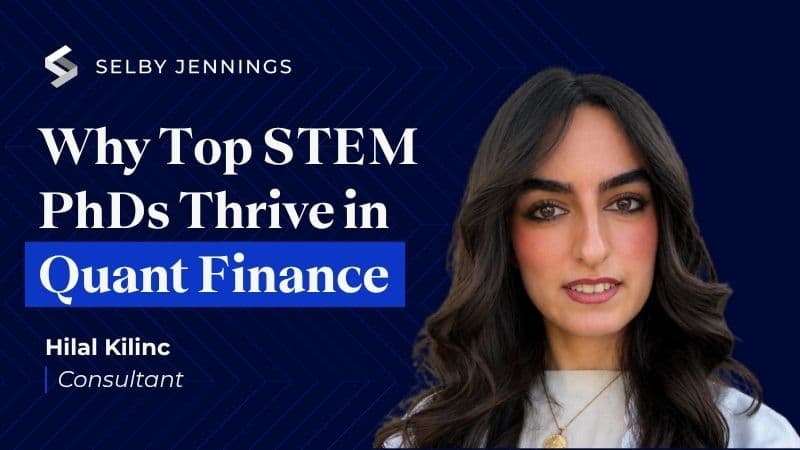
For PhDs at leading universities studying mathematics, physics, machine learning, and computer science, the move from academia to industry can feel like a massive shift. In reality, for those considering quantitative finance, it is often a natural continuation of the work they are already doing.
It is a shift Hilal Kilinc, Consultant at Selby Jennings, is seeing more often, with STEM PhDs increasingly looking at quant finance as a career path where their research experience, technical depth, and problem-solving ability can transfer directly into industry.
Quantitative trading and research roles demand exactly what top PhDs are trained to deliver: rigorous thinking, analytical depth, and the ability to solve complex, open-ended problems under uncertainty.
Why PhDs are a natural fit for quant roles
Quantitative finance is one of the few industries where academic-style thinking isn’t just appreciated, but actively enables you to excel.
1. You already solve the right kind of problems
PhD research typically revolves around problems that involve:
- No clearly defined solution
- High levels of complexity
- Significant ambiguity and uncertainty
This closely mirrors responsibilities in the quant space, where individuals can be expected to:
- Extract robust signals from data sets
- Develop, test, and refine predictive models or run trading strategies
- Work through iterative, feedback-driven research cycles, where ideas are continuously challenged, validated, and improved in a highly competitive environment
Whether you have worked on stochastic PDEs, reinforcement learning, statistical inference, or large-scale systems, the structure of your thinking and problem-solving approach is directly transferable.
2. A skillset that transfers directly to industry
Beyond technical knowledge, a PhD candidate builds a set of highly valuable transferable skills that are essential in quant roles:
- Problem solving: The ability to break down complex problems into structured components, develop ideas, and test them, mirroring the open-ended nature of real-world quantitative research.
- Analytical thinking: Approaching problems with rigour and logical consistency
- Communication: Explaining complex ideas clearly to both technical and non-technical audiences
- Resilience and iteration: Handling unexpected outcomes, refining approaches, and continuously improving
These are not just academic traits; they are exactly what firms look for when hiring researchers who can operate and generate ideas in a fast-paced environment.
3. Mathematical and statistical depth is core to alpha
Unlike many industries where technical skills are diluted over time, quant finance compounds them.
Your understanding in:
- Probability theory and distributions
- Statistical methods
- Optimisation techniques
- Time series modelling
becomes your strength.
4. Programming is a key differentiator
Modern quant roles sit at the intersection of theory and implementation.
PhDs often already have:
- Strong coding ability
- Experience working with large or complex datasets
The ability to translate ideas into working models is one of the most valuable assets within quant teams.
5. Intellectual independence = Idea generation
In academia, you are trained to:
- Formulate hypotheses
- Design experiments
- Draw conclusions independently
In quant finance, this becomes your edge. The best researchers are not just implementers; they are idea generators who can propose new strategies or encourage the refinement of existing ones.
How PhDs can prepare for quant interviews
PhDs can be strong candidates for quantitative finance roles, but quant interviews are highly structured, technical and competitive. Academic strength helps, but it is not enough on its own.
For PhD candidates, preparation needs to go beyond general interview advice. You will often be tested on academic concepts, technical problem solving, coding ability and your ability to explain complex research in a clear, commercial way.
1. Be ready to discuss your research clearly
Your PhD is one of your strongest assets use it well.
Be prepared to explain:
- Your research problem
- Motivations of research
- The methods you used
- The technical challenges you faced
- Your findings
- The impact of your research
Strong candidates can translate complex academic work into a clear narrative. They can also show how their research experience connects to real-world problem solving.
This matters because firms are not only assessing what you know. They are assessing how you think, communicate and handle complex problems under pressure.
2. Refresh core probability and statistics
Probability and statistics are central to many quant interviews. For PhD candidates, firms often expect a high level of technical fluency.
You should be comfortable working through problems quickly and clearly, often without much prompting.
Focus on areas could include:
- Probability distributions
- Conditional probability
- Expected value
- Variance and covariance
- Regression
- Stochastic processes
This is where many academic candidates underestimate the process. A strong research background does not always translate into fast interview performance. You need to practise solving problems out loud, under time pressure.
3. Practise quant brain teasers and structured problem solving
Many firms use brain teasers and logic problems to test how you think.
These questions may assess:
- Logical reasoning
- Structured thinking
- Numerical intuition
- Communication under pressure
- Ability to adapt when challenged
The goal is not just to reach the right answer. Interviewers want to see how you get to the solution.
Talk through your assumptions. Break the problem down. Check your logic as you go. A clear method can make a stronger impression than a rushed answer.
4. Strengthen your coding skills
Most quant interview processes include a coding assessment at some stage.
You may be tested through:
- Live coding
- Take-home tests
Depending on the position, this could be in Python or C++
They want to see how you approach coding problems within a time frame set.
5. Understand the quant finance space
You do not need deep financial markets experience to move from academia into quant finance. However, you do need to show that your interest is informed and credible.
You should understand:
- Why quantitative finance appeals to you
- The difference between Quant Research, Trading, Analytics and Development and which one you would like to pursue
- Where your skills fit best
- Why a specific firm interests you beyond its brand name
- How your academic background could add value in a commercial setting
This is especially important for PhD candidates. Firms want to know that you understand the move from academia into industry, and that you have thought seriously about the type of role that suits you.
6. Speak to people already in the industry
One of the best ways to prepare is to speak with experienced quants, especially those who moved into the industry after a PhD.
These conversations can help you understand:
- What the day-to-day work looks like
- How different quant roles vary
- What firms expect from PhD candidates
- How interview processes differ by firm and region
- Which technical areas you should prioritise
This can help you prepare in a more focused way, rather than treating all quant roles as the same.
7. Build commercial awareness
PhD candidates are often strong technically, but some struggle to show commercial awareness.
You do not need to become a markets expert before interviewing. But you should follow financial news within the quant space and stay curious about how markets behave.
This shows that you understand that quant finance sits within an intellectual and fast paced environment and this is where you can see yourself learn and grow in within your career trajectory.
8. Work with a specialist recruiter
A specialist quant recruiter can help you understand where your profile fits best.
The right recruiter can:
- Assess your technical background
- Match you with suitable quant roles
- Explain differences between firms, teams and regions
- Help you prepare for interview formats
- Give feedback on how to present your academic experience
Used well, this support can help you move from being a strong technical candidate to a well-prepared, well-positioned one.
Next steps
For PhDs in maths, physics, machine learning, and computer science, quantitative finance is one of the most intellectually aligned career paths available outside academia.
You are not starting from scratch, you are applying a highly specialised, transferable skill set in a new context.
You will:
- Continue solving complex problems
- Work with advanced mathematical and computational tools
- Leverage the same analytical and research skills developed during your PhD
As Hilal puts it:
Many STEM PhDs underestimate how well their research experience translates into industry, particularly within quant finance. The ability to generate ideas, test them rigorously, and clearly communicate complex thinking directly translates into the technical skills looked for within quant finance.
Your PhD has already given you many of the skills quant finance firms value most. The next step is positioning that experience in the right way and targeting roles that match your technical background, research interests, and long-term career goals.
Submit your CV
If you are a STEM PhD considering a move into quant finance, now is the right time to explore the market. Register your CV below to speak with Hilal about your options, or look at our current quant finance roles to see where your skills could take you next.