

December 2025
Financial Technology: 2026 Talent Insights
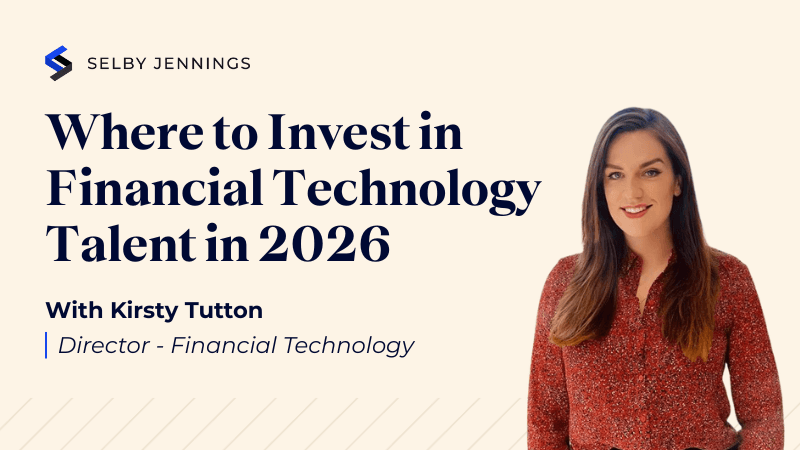
The pace of change in financial technology accelerated significantly in 2025. With AI adoption rising, infrastructure investment growing, and firms expanding into new European locations, hiring strategies across fintech are evolving fast.
In this video, Kirsty Tutton, Director at Selby Jennings, shares key hiring insights from across the financial technology sector and offers practical guidance for firms and professionals navigating 2026. Read a summary of her insights below too.
What changed in financial technology hiring in 2025, and how did that impact the market?
"AI dominated the financial technology agenda in 2025. From hedge funds to enterprise platforms, firms invested heavily in AI capabilities, driving demand for AI engineers, machine learning engineers, and data engineers. But success didn’t just come from hiring top tech talent. It relied on strong data infrastructure, which became a critical differentiator for early adopters.
"Meanwhile, several companies moved to expand their footprint beyond traditional hubs. European cities like Warsaw and Krakow saw increased hiring activity, as firms looked to tap into new talent pools outside of saturated locations like London.
"Hiring processes also evolved. Stricter interview structures became more common, particularly for technical roles. Simultaneously, some firms moved back to in-office working models, with a return to five-day office attendance becoming more frequent. Non-compete and notice periods also lengthened, particularly at hedge funds and competitive trading firms."
What should financial technology firms and professionals prioritize in 2026?
"Now is the time to focus on infrastructure and pipelines. Firms planning for 2026 should continue investing in their data architecture to support scalable AI deployment. Without robust infrastructure, productivity gains from AI will remain limited.
"From a talent perspective, early pipeline development is essential, especially when targeting candidates from competitor hedge funds or financial technology firms. Restrictions on notice periods and non-competes are growing longer, so forward planning is key to onboarding talent in a timely manner.
"Hiring strategies also need to broaden. Talent outside of London is increasingly viable, particularly in high-growth tech hubs across Europe. Expanding your search radius can improve speed, access, and sometimes cost-efficiency.
"Finally, streamlining interview processes remains important. As the competition for AI and software engineering talent increases, firms with faster, more focused hiring journeys are more likely to secure high-quality candidates."
How is AI impacting roles in financial technology?
"AI is no longer siloed to specific projects, it’s becoming embedded into every role across the sector. Software engineers, product managers, and data teams are all expected to interact with or build AI-powered tools.
"Importantly, AI is not just about replacing tasks. It’s about boosting productivity. The most successful firms are using AI to improve development cycles, automate operational work, and generate new value from existing data.
"In 2026, demand will continue to rise for AI engineers, machine learning specialists, and data engineers, particularly those who can integrate models into live trading and decision-making environments. As AI becomes foundational across the sector, technical fluency will be critical for both current and emerging talent."
To discuss your hiring plans for 2026 or explore current financial technology opportunities, request a call back or browse open roles.


FAQ: Financial technology hiring, careers & compensation in 2026
Fintechs are hiring technical talent that can build and scale core products, including Full Stack, Backend and Mobile Engineers, Data Scientists, Cloud/DevOps specialists, and Security professionals. There’s also rising demand for compliance, risk, and regulatory operations roles to support evolving EU frameworks, and for leaders with experience in payments, open banking, and embedded finance.
Selby Jennings works with fintech leaders to build specialised teams that reflect these priorities. Request a call back to discuss your hiring strategy.
Beyond core languages such as Python or JavaScript, employers value experience with API design, cloud platforms (AWS, GCP, Azure), real time data processing, and AI/ML workflows. Regulatory tech, risk automation, KYC/KYB tools, and fraud detection systems are also key, particularly as companies scale into new markets and prepare for future rule changes.
Selby Jennings helps firms refine job specifications so you can attract candidates with the right combination of technical depth and regulatory awareness. Learn more about our financial technology talent solutions.
Today’s candidates expect clarity on role scope, tech stack, and growth opportunities before interviews begin. A streamlined process with fast feedback, transparent compensation bands, and real world technical challenges (e.g. coding exercises or system design) helps firms stand out. Setting out role expectations early also prevents slow hiring processes from losing candidates to competitors with better communication.
If your firm is struggling to secure the fintech talent you need, Selby Jennings can help structure your recruitment process to reduce time to hire and improve conversion. Request a call back to learn more.
Many roles – especially in engineering, product, and compliance – are offered in hybrid or remote formats, and many fintech professionals search for flexibility alongside strong team collaboration practices. Clear expectations about remote work tools, synchronous vs asynchronous work, and professional development paths make hybrid offers more compelling.
We can advise on role design that attracts remote ready talent without compromising team cohesion. Speak to a specialist to learn how we can support your hiring needs.
Europe’s financial technology scene offers a broad range of roles, from frontend, backend, and full stack engineering to data science, cloud architecture, cybersecurity, product ownership, and risk & compliance. Emerging functions tied to AI/ML, regtech, and open banking are particularly hot.
Create an account with Selby Jennings to connect with opportunities across these functions and more.
Candidates should build proficiency in cloud technologies, API design, data engineering, secure development, and AI/ML frameworks. Experience working within regulated environments and with financial protocols (e.g., PSD2/Open Banking standards) also boosts competitiveness.
While compensation varies by role and market, fintech salaries in cities such as London, Berlin, Amsterdam, and Paris remain strong to attract scarce technical talent. Highly specialised engineers, AI/ML experts, and senior product leaders often command premium packages, including equity or long term incentives, reflecting tight competition for skills.
For the latest salary and bonus benchmarks, download our Global Financial Technology Compensation Guide, or browse live fintech roles to compare packages in your field.
Expect coding tests (algorithms, system design), real world problem solving, and discussions on product architecture. Interviews increasingly include questions on DevOps practices, cloud deployment, security best practices, and how candidates have used data workflows or AI/ML in practical applications.
Selby Jennings offers interview preparation support tailored to both technical stages and culture fits for the professionals we work with. Register with us today to start being shortlisted for fintech roles.