

The Shift Towards Specialist Engineering Talent
July 2026Sam Tenzer5 min read
The Shift Towards Specialist Engineering Talent
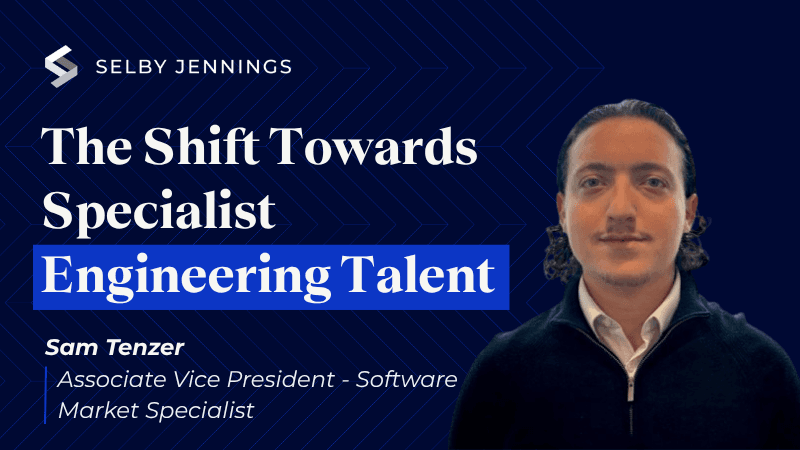
Software engineering remains one of the most competitive hiring markets in financial technology, but the profile of the ideal candidate is changing.
As trading firms push for greater performance, faster execution, and increasingly sophisticated infrastructure, demand is shifting away from broad software engineering experience towards highly specialized systems engineering expertise.
We sat down with Associate Vice President Sam Tenzer to discuss what is driving this change, how it is affecting salaries, and what employers should be thinking about over the next 12 months.
Software engineering salaries continue to rise. What's driving the market?
"The biggest trend we're seeing is the growing separation between banks and the buy side.
"Banks still have relatively structured salary bands, and compensation is usually aligned with seniority, so budgets are tied to titles such as Vice President, Director or Managing Director.
"Hedge funds, market makers and high frequency trading firms, however, operate very differently.
"They're paying for specialist capability rather than years of experience. We're regularly seeing base salaries reach £300,000 for top C++ and low latency engineers, with total compensation packages exceeding £500,000.
"The market has become much more skills-driven. In other words, two engineers with the same level of experience can command very different salaries depending on the complexity of the systems they've built and the environments they've worked in."
What skills are firms prioritizing?
"The focus has shifted away from general software development towards specific systems engineering.
"Clients are looking for engineers who understand how software interacts with hardware, networking and trading infrastructure. Skills in distributed systems, linux kernel development, performance engineering and production-scale infrastructure are becoming increasingly valuable.
"We're also seeing demand grow for engineers with experience in areas such as exchange connectivity, market data infrastructure, matching engines, order routing systems, feed handlers, hardware-aware optimization and lock-free concurrency.
"These are the skills that consistently appear when firms assess candidates for front office engineering teams."
Is your previous employer becoming more important?
"Very much so. Pedigree has always mattered, but it's becoming even more influential.
"Clients look closely at educational background, engineering programs and previous employers. Candidates coming from leading systematic hedge funds, proprietary trading firms and market makers immediately attract attention because they've already demonstrated they can perform in demanding, low latency environments.
"At the same time, many of the largest systematic trading firms are now hiring almost exclusively from within the industry.
"Historically, firms were more open to recruiting engineers from big technology companies, but increasingly, they're targeting talent from competitors who already understand financial markets and trading infrastructure."
How can firms attract candidates when everyone is competing for the same talent?
"Compensation is only one part of the picture. The strongest candidates often have several opportunities running at the same time, so firms need to demonstrate why their role is worth choosing.
"Technical ownership is a major factor. Engineers want to work on challenging problems, contribute directly to revenue generation, and have close exposure to traders and the wider business.
"We've seen candidates accept slightly lower offers because the work itself was more interesting or because they would have greater ownership over the systems they were building.
"The hiring process also plays a much bigger role than many employers realize.
"Counter offers are becoming increasingly common, so speed and candidate engagement can make the difference between securing a hire and losing them to a competitor."
Has AI changed technical hiring?
"It has created an interesting challenge. AI has become part of the way most software engineers work. It's completely normal to use it to speed up development or troubleshoot problems. But when candidates interview, many employers still expect them to complete coding assessments without any AI assistance. That creates confusion because the interview no longer reflects the reality of the role, and candidates are left trying to balance demonstrating their own technical knowledge with the way they'd naturally work on the job.
"Some firms are adapting their approach by giving candidates larger coding exercises before reviewing the work together in a technical discussion. That allows candidates to demonstrate how they use AI while also proving they understand and can validate the code they've produced. It's overall a much more realistic reflection of how software engineers work today."
What advice would you give hiring managers?
"Candidate experience matters more than ever. Too many firms begin the process by sending coding assessments without first introducing the opportunity, for example.
"The best engineers are often speaking to multiple companies simultaneously, so if your first interaction is simply asking someone to spend several hours completing an assessment, you're already putting yourself at a disadvantage.
"A live conversation early in the process gives candidates the opportunity to understand the role, the engineering challenges, and the culture before committing their time. They’re bought in.
"When competition for talent is this intense, those small differences really do have a significant impact."
What advice would you give professionals?
"Preparation remains one of the biggest differentiators.
"Many engineers spend years working in highly technical environments but haven't been interviewed recently. Timed coding assessments require practice, regardless of experience.
"Technical ability also isn't enough on its own.
"Clients increasingly want engineers who can communicate with non-technical stakeholders, understand how the business generates revenue, and explain the commercial value of the systems they build. Those soft communication skills are becoming just as important as technical expertise."
Get in touch today
Good hiring decisions rely on current market intelligence. While online research can provide a starting point, speaking to specialists who work with employers and financial professionals every day gives you a clearer picture of compensation, talent availability and hiring trends.
Get in touch with Sam Tenzer and the wider Selby Jennings team to discuss your hiring plans or explore opportunities across financial technology.
Explore Related Insights
Let’s talk talent
Need the right talent for your next hire, or guidance on your people strategy? Leverage our experience to help you and your business today.
Advancing your career
Want to be one step ahead in your career? Our industry experts have the relationships and global reach to realise your full potential.